NIBIN and the Crime Gun Intelligence Center Model: Where the Ballistic Evidence Backlog Actually Sits
ATF requires ballistic evidence entered into NIBIN within two business days. Agencies that miss the standard are usually failing at intake, not ballistics.
By IPA-IAC · 6 min · 6 October 2026
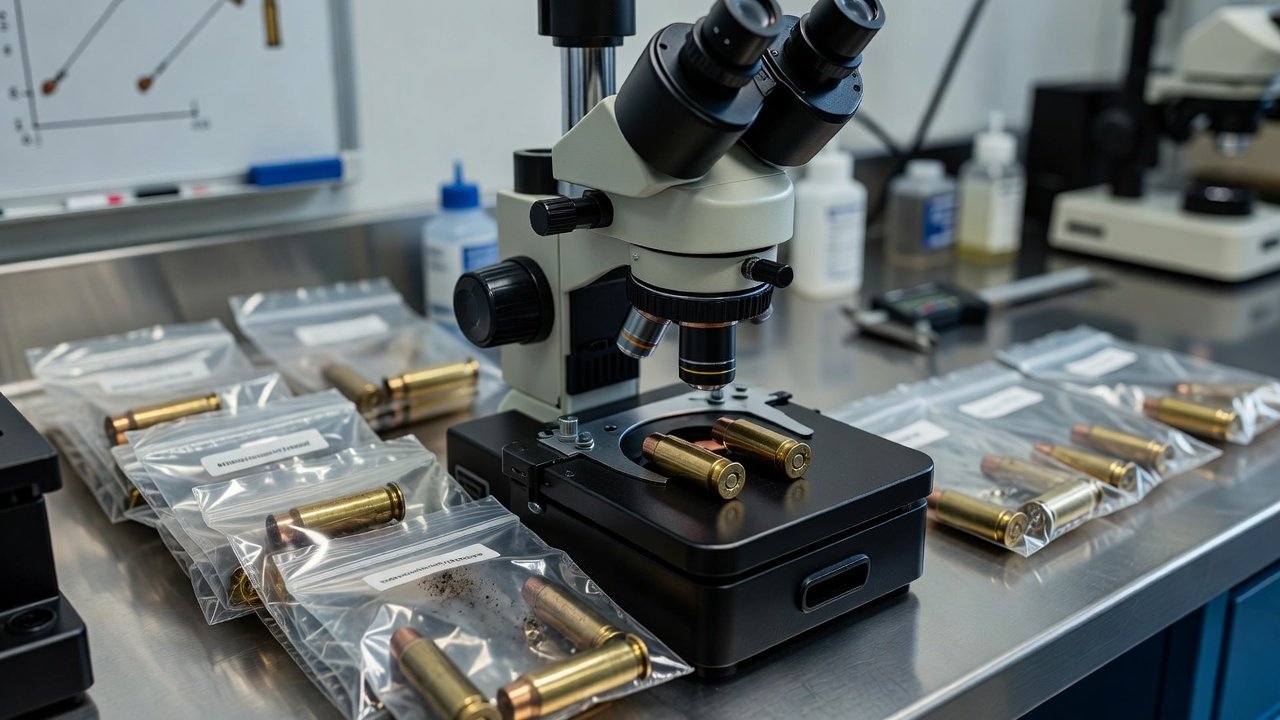
A shooting scene generates cartridge casings within minutes. Whether those casings produce an investigative lead in two days or two months depends less on ATF’s National Integrated Ballistic Information Network than on what happens to the casings before they ever reach a NIBIN acquisition station. That distinction — network capability versus agency intake discipline — is where most of the confusion about the “NIBIN backlog” starts, and where mid-size agencies keep losing time they don’t have to lose.
What NIBIN Actually Links
NIBIN is ATF’s national platform for correlating fired cartridge casings and bullets across jurisdictions. A casing recovered at a shooting in one city can be automatically compared against casings entered by any other participating agency in the network, surfacing a probable match — a “lead” — when the same firearm was used in an earlier, unrelated incident. The ATF’s NIBIN program page describes this as the only interstate ballistic correlation system available to state and local law enforcement, and it is the mechanism that turns a single recovered gun into a map of every shooting scene it touched.
The correlation itself is fast — often same-day once evidence is in the system. Newer 3D virtual-comparison technology, which some sites are piloting alongside the older 2D imaging approach, has further shortened the time examiners need to confirm a probable match once casings are entered. The bottleneck agencies actually experience sits upstream: getting a casing off an evidence shelf and into a NIBIN acquisition machine in the first place.
The Two-Business-Day Standard, and Why It’s Missed
ATF’s Minimum Required Operating Standards for NIBIN sites, updated in 2018, require that fired or test-fired cartridge casings be entered into the system within two business days of an agency receiving them, with any resulting investigative lead disseminated to detectives within 24 hours. Sites meeting the higher “Gold” tier standard have reported averaging roughly 1.4 business days from receipt to entry — faster than the floor, not the exception at well-resourced sites.
Mid-size agencies without a dedicated NIBIN technician miss the standard for ordinary operational reasons: casings sit in a property room queue behind other evidence types, the officer or technician trained on the acquisition station also covers other duties, or there’s no daily transport routine moving casings from patrol districts to the site with the machine. An agency that shares an acquisition machine with several neighboring jurisdictions adds a scheduling layer on top of that — casings compete for machine time against every other participating department’s queue, not just the host agency’s own caseload. None of that is a NIBIN capacity problem. It’s a staffing, transport, and scheduling problem that happens to show up as a NIBIN delay.
What the Crime Gun Intelligence Center Model Changes
The Crime Gun Intelligence Center approach, developed by ATF and funded through the Bureau of Justice Assistance’s CGIC Integration Initiative, doesn’t change NIBIN’s technology — it changes the organization around it. A CGIC combines timely NIBIN entry with immediate investigative follow-up, typically through a dedicated team that treats a NIBIN lead as an active tasking rather than a report that circulates when someone gets to it. BJA’s program overview has funded dozens of local sites to replicate this structure, and the national CGIC best-practices guidance is explicit that a NIBIN hit with no assigned follow-up produces no public-safety value at all — the correlation has to feed an investigator working the case within days, not eventually.
For agencies deciding whether a CGIC structure is worth the reorganization, the honest answer is that it addresses exactly the failure point mid-size departments hit: it assigns ownership of the two-day entry standard to a specific person or unit, and it builds the follow-up step into the same workflow instead of treating it as a separate referral. BJA’s funding model reflects that priority — grants under the CGIC Integration Initiative are structured around building or sustaining the interagency team (typically combining a local agency, ATF, and a prosecutor’s office) rather than purchasing additional NIBIN hardware, because the hardware was rarely the constraint to begin with.
What a CGIC Follow-Up Team Actually Does Differently
The operational difference between a NIBIN hit that sits in an inbox and one that becomes an arrest usually comes down to whether someone owns the next step by default. A functioning CGIC assigns every NIBIN lead to a specific detective or task-force member within the 24-hour dissemination window, with a documented expectation that the assignee makes contact — a records check, a call to the original case’s lead investigator, a review of the connected incident reports — before the lead goes cold. Agencies without that structure often route leads through a general notification list, where a hit gets read but not necessarily acted on unless the receiving detective already has bandwidth. The national CGIC best-practices guidance treats this ownership gap as the single most common reason a technically well-run NIBIN program still fails to produce prosecutions.
Where Backlogs Genuinely Persist
Two different things get called “the ballistics backlog,” and conflating them causes bad diagnosis. NIBIN acquisition and correlation — getting a casing scanned and compared — is the fast part when an agency runs it on schedule. Full firearms examination and traditional forensic comparison at a state crime lab, which produces court-admissible testimony rather than an investigative lead, is a separate and often much slower process; some state labs have reported backlogs running past a year for full comparative analysis, independent of how quickly NIBIN itself correlates evidence. An agency that fixes its NIBIN intake timeline has solved the lead-generation problem. It has not touched the lab-capacity problem behind full forensic casework, which needs its own staffing investment.
Agencies evaluating their own performance should ask two separate questions rather than one: how long from recovery to NIBIN entry, and how long from a NIBIN lead to an assigned follow-up. Most backlog complaints trace to the first question, and the OJP’s field-lessons report on CGIC practices is consistent that agencies who fix intake timing see the return quickly, because the correlation technology was never the constraint.
For an agency deciding where to invest limited resources, the CGIC model’s actual value proposition is organizational rather than technical: it forces a written answer to “who enters casings within two days, and who picks up every lead within 24 hours” — questions many mid-size departments have never assigned to a specific role, and the gap between the standard and the outcome closes as soon as they do.