Fentanyl Field Testing and the "Contact Overdose" Myth: What Changed in Officer Safety Protocol
The 2017 ACMT/AACT statement found no evidence of overdose from touching fentanyl. Field-testing gear has since changed to match what that evidence shows.
By IPA-IAC · 6 min · 27 October 2026
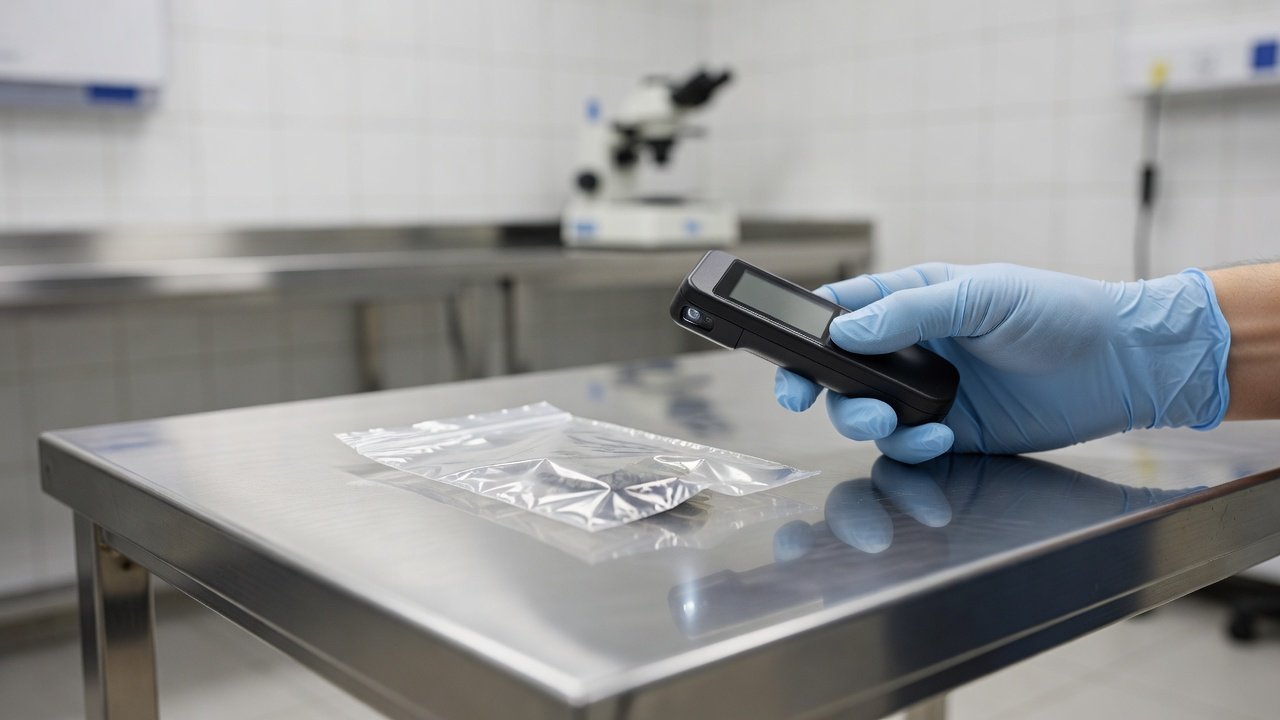
For several years, roadside and evidence-room videos of officers collapsing after brushing against a white powder circulated as proof that touching fentanyl could cause an overdose. The toxicology evidence never supported that account, and the professional bodies that study opioid exposure said so clearly in 2017. What has actually changed since then isn’t the underlying science — it’s the field-testing equipment agencies now use, which sidesteps the exposure question almost entirely by letting officers identify a substance without touching or opening its container.
What the 2017 Position Statement Found
The American College of Medical Toxicology and the American Academy of Clinical Toxicology jointly reviewed the available evidence on occupational fentanyl exposure and published findings that directly contradicted the passive-exposure warnings circulating at the time. Their position statement concluded that incidental skin contact with fentanyl or its analogs is exceedingly unlikely to cause any measurable opioid effect, because dermal absorption of fentanyl is slow and inefficient compared to the routes — injection, inhalation of aerosolized particles, or mucous membrane contact — that actually produce toxicity. The statement noted that a properly worn pair of nitrile gloves provides sufficient protection for routine handling, and that an N95 respirator is warranted only in the rarer scenario where drug particles are aerosolized, such as during clandestine lab processing. A 2016 DEA warning to law enforcement about passive fentanyl exposure risk, which had helped drive the more alarming protocols in circulation, was not backed by the toxicological evidence available at the time it was issued.
Where the Myth Came From
Researchers who later studied reported field “overdoses” following incidental contact found a consistent pattern that didn’t match opioid toxicity: rapid onset of symptoms — often within seconds, faster than dermal fentanyl absorption could plausibly act — combined with anxiety-driven presentations like hyperventilation and dizziness rather than the respiratory depression that characterizes actual opioid overdose. The pattern is consistent with the nocebo effect, in which a person who believes they’ve been exposed to something dangerous develops real physiological symptoms from that belief rather than from the substance itself. That doesn’t make the officer’s distress performative or the incident meaningless — it means the intervention that helps is reassurance and, when needed, standard medical evaluation, not naloxone administered on the assumption of opioid toxicity that testing later fails to confirm.
How Field Testing Technology Has Actually Changed
The equipment shift is the more durable change. Older colorimetric test strips and reagent kits require opening a container and physically contacting a sample, which is exactly the exposure route the 2017 statement said carries the most theoretical (if still low) risk when the substance is unknown and could be aerosolized during handling. Portable Raman spectroscopy readers — handheld devices used by an increasing share of agencies — measure a substance’s molecular signature through a sealed bag or clear container without opening it, comparing the result against a built-in reference library that includes fentanyl and multiple analogs. Federally supported evaluation work on field-portable identification instruments has continued refining these reference libraries specifically because analog variation makes single-substance test strips less reliable as new formulations appear.
The safety benefit of non-contact scanning isn’t that the older risk was as severe as early reporting suggested — the 2017 evidence already showed it wasn’t — but that a device requiring zero physical contact with an unknown substance removes the exposure question from the protocol entirely, rather than relying on gloves and training alone to manage a risk that was already small.
Devices like Smiths Detection’s ACE-ID, one of the more widely fielded handheld Raman units, ship pre-loaded with a reference library covering common cutting agents alongside multiple fentanyl analogs, and vendors update those libraries as new analogs appear on the street. That update cycle matters more for Raman than it did for older colorimetric strips: a strip is built to react to a specific chemical class, while a spectroscopic reader is only as useful as the reference spectra it has on file, so an agency relying on Raman identification should confirm its library refresh schedule rather than assuming a device purchased several years ago still recognizes the current analog landscape.
Evidence Handling Still Has to Meet Chain-of-Custody Standards
A presumptive field identification, whether from a test strip or a Raman reader, is not a substitute for laboratory confirmation, and agencies should be careful not to let faster, safer field identification blur into treating field results as final. The evidentiary value of a Raman scan depends on documenting the device, the reference match, and the officer who ran it with the same rigor applied to any other presumptive test — the technology changes the exposure risk, not the documentation burden. Evidence still needs to move into secure storage and, where prosecution is likely, into laboratory analysis that can withstand a defense challenge, following the same chain-of-custody discipline that governs any other controlled-substance evidence.
What an Evidence-Based Protocol Looks Like Now
Agencies updating field protocols against the current evidence, rather than the earlier alarm, are converging on a few consistent elements: nitrile gloves as the default PPE for routine handling of suspected fentanyl, with N95 respirators reserved for situations involving visible powder disturbance or suspected aerosolization rather than issued as standard equipment for every stop. Non-contact identification tools — Raman readers where budget allows, standard test strips with appropriate glove protocol otherwise — are prioritized over any protocol that requires opening a container in the field when it can be avoided. And officer training now explicitly addresses the nocebo pattern, so that a colleague’s anxiety symptoms after a suspected exposure are met with calm assessment rather than reinforcing the belief that touching the substance was independently dangerous, which research suggests is what perpetuates the cycle at agencies that haven’t updated their training.
Training deserves as much weight in the protocol as equipment does. An agency that issues a Raman reader but never retrains supervisors and field training officers on what the 2017 evidence actually says will still see the older, more alarmist response pass down informally through shift culture, regardless of what the written policy says. Roll-call briefings that walk through the ACMT/AACT findings directly — not a summarized rumor of them — and post-incident debriefs that name the nocebo pattern when it’s the likely explanation are what actually change field behavior over time, more than a policy update alone does.
None of this argues for carelessness around an unknown substance that could, in less common scenarios, be genuinely hazardous. It argues for matching the response to what the toxicology actually shows: proportionate PPE, non-contact testing where practical, and training that treats the fentanyl exposure question as settled science rather than an open threat that still drives overreaction in the field.